Setpoints, Sensors, and the Plant in the Middle
Growing Systems · July 9, 2026 · 9 min read
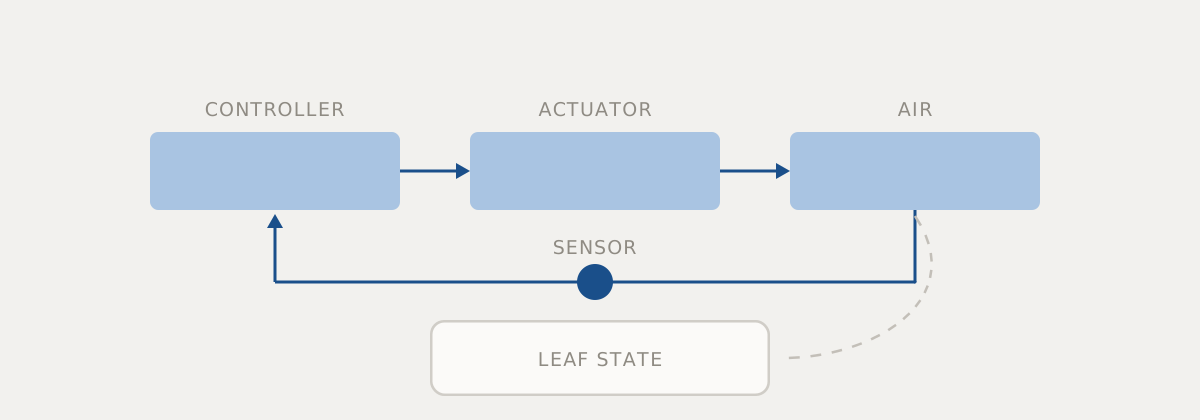
A climate computer will hold a setpoint beautifully. The trend line sits flat, the alarms stay quiet, the report at the end of the week shows compliance in the high nineties. And the crop can still be wrong, because the controller was regulating something the plant does not directly experience.
That gap — between the variable you can hold and the variable that drives the biology — is the recurring structure in every growing system, indoors and out. It is worth setting out as a control problem, because the failures are control failures and they have control-shaped fixes.
The controlled variable is a proxy
Air temperature is measured because it is easy to measure. What governs the rate of biological processes is tissue temperature, and a leaf is not at air temperature. It gains heat from radiation, loses it by transpiration, and exchanges it with the air at a rate that depends on how fast the air is moving past it. Under strong light with the stomata closed, a leaf can sit well above the air around it. Under high transpiration it can sit below. The controller sees none of this.
Humidity is worse, because relative humidity is a ratio whose denominator moves with temperature. Two rooms at the same relative humidity and different temperatures present the plant with different drying power. This is why serious operations control vapour pressure deficit instead — the difference between the water vapour pressure inside the leaf and in the surrounding air, which is much closer to the quantity that actually drives transpiration and stomatal behaviour.
Moving from relative humidity to a deficit is a real improvement, and it is still a proxy. The deficit is computed from air temperature and humidity, while the physically relevant gradient runs from the leaf’s internal air spaces to the boundary layer at its surface. The substitution is made because measuring the leaf continuously across a whole crop is impractical — a legitimate engineering compromise, right up until the compromise is forgotten and the proxy is treated as the thing itself.
The actuators are coupled and slow in different ways
Single-loop control fights itself in a greenhouse, because almost nothing you can actuate affects only one variable.
Opening a vent lowers temperature, lowers humidity, and moves the carbon dioxide concentration towards ambient, all at once, at rates set by wind and by the temperature difference across the opening. Closing a thermal screen changes the radiative balance and the air exchange and the light reaching the crop. Turning on lighting adds heat. Irrigating changes root-zone conditions immediately and canopy humidity some time later.
Set independent loops on temperature, humidity and carbon dioxide, and they will work against one another in ways that look like tuning problems and are actually structural. The archetypal case is dehumidifying by venting while the heating runs to hold the temperature setpoint — a stable, compliant, quietly expensive equilibrium in which two actuators cancel each other and the energy meter pays for the disagreement.
Time constants compound it. Air responds in minutes, the structure and root zone in hours, the crop’s physiology over days. A strategy that does not distinguish these will chase noise at one timescale while missing drift at another.
One sensor stands in for a volume it was never validated against
Placement usually dominates instrument accuracy, and it is far cheaper to get wrong.
A growing space has gradients: vertically between floor and canopy top, horizontally between the gable end and the middle, locally around a heating pipe, a fan, a door that opens, a patch of sun landing on a sensor housing. A laboratory-grade sensor mounted where the air does not represent the crop produces precise, confident, unrepresentative numbers, and the controller acts on them everywhere.
The practical questions are not about specifications. Where is this sensor relative to the canopy, and does it move as the canopy grows? Is it aspirated, or reading its own radiative gain on sunny afternoons? How much do two sensors in nominally identical positions disagree — and if nobody has ever put two in, the spatial uncertainty is unknown and almost certainly larger than the instrument’s stated error.
Outdoors, the same problem with far less observability
Precision agriculture is the same control loop with the enclosure removed. You cannot actuate the weather, so the controllable inputs narrow to what you apply and where — seed, water, nutrient, crop protection — and the interesting question becomes spatial rather than temporal.
Three resolutions have to line up before variable-rate application creates any value. The resolution at which the underlying variation actually exists in the field. The resolution at which you can sense it. And the resolution at which the machine can change what it is doing, given boom width, section control, valve response and the speed it travels at. A prescription map drawn finer than the implement can act is a map that gets averaged away at the nozzle. A map drawn coarser than the real variation smooths across the differences that mattered.
Two further conditions are easy to skip. The variation must be persistent — a pattern that reshuffles between seasons cannot be managed by last year’s map. And the crop’s response to the input must differ across the zones, because if it responds the same way everywhere, varying the rate changes cost and nothing else. Plenty of variable-rate programmes fail those tests and are judged instead on whether the map looked convincing.
The response integrates, so compliance is not the objective
The final structural feature is that plants integrate. Light is accumulated over the day; development accumulates with warmth over the season; water stress accumulates and then expresses itself well after the event that caused it.
This changes what a good week looks like. Holding a setpoint perfectly is not the goal, and a controller judged on setpoint compliance can be optimising the wrong quantity — particularly where a deliberate excursion is the correct move, such as accepting a warmer period to bank development, or a cooler one to slow it. What matters is the integral and its distribution over time, not the variance around a line.
Heat accumulation is the clearest example, and the arithmetic is simple enough to do by hand — which is why it is worth understanding rather than trusting: the growing degree day calculator on this site walks through it, including the point that different agencies apply different cutoff conventions to the same daily temperatures and get different totals.
What this means for anyone building the controller
Three things follow, and none require better hardware.
State the proxy chain explicitly, in the documentation and preferably in the interface: what is measured, what is inferred, what the plant experiences, and where the chain is weakest. Coordinate the actuators rather than looping them independently, because the couplings are physical and will not tune away. And judge the system on accumulated outcomes over the crop cycle rather than on how flat the trend lines were.
A growing system is a control loop wrapped around a plant nobody can see properly, running on inferred variables, actuated by devices that interfere with each other, and evaluated weeks later. Written down that way it sounds difficult, which is accurate, and considerably more useful than a dashboard full of green.