Evolution Was Solving a Different Problem
Design Limits · June 23, 2026 · 9 min read
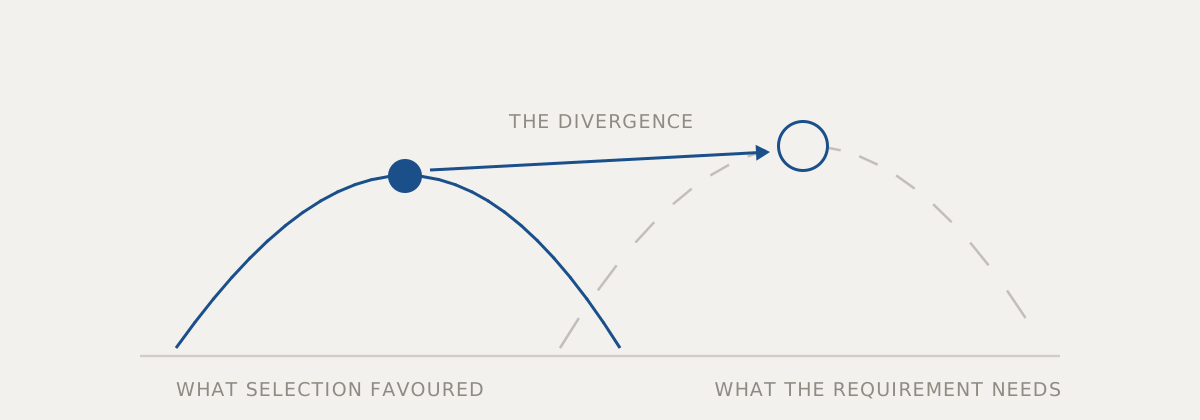
The pitch is familiar enough to be recited: this design draws on millions of years of refinement, so the hard work has already been done. It is a comfortable line and it contains one serious error. Evolution is not a long research programme aimed at good engineering. It is a filter, and it was filtering for something other than what you are being paid to deliver.
That does not make biological mechanisms less useful. It makes them useful in a specific, bounded way — and the boundary is exactly where most nature-inspired projects fail, usually late.
The objective function you are inheriting
What gets selected is whatever leaves more descendants in a particular environment, integrated across a whole organism, subject to whatever developmental machinery already existed. Nothing in that sentence mentions efficiency, cost, manufacturability, service life, maintainability, or the single subsystem you happen to be interested in.
Five consequences follow, and they are worth writing down separately because they fail in different ways.
Functions come bundled. A biological structure is rarely doing one job. The same surface may carry load, shed water, regulate temperature, signal to other individuals, host microorganisms, and grow. Its geometry is a settlement between those demands. When you extract it for the one function you care about, you inherit a shape that was compromised for five others — so it will usually underperform a shape designed for your single objective, unless the compromise happens to point your way.
The search could not start anywhere. Every viable form has to be reachable by continuous small modifications from a form that already worked. Whole regions of the design space are simply unreachable, not because they are worse, but because the path to them runs through configurations that are worse. Biology is therefore full of arrangements that are locally excellent and globally odd: routings that double back, structures repurposed from a completely different original job, redundancy that exists because removing it was never a viable intermediate step. An engineer can start anywhere in the space. Copying a local optimum from a search that could not is giving up your main advantage.
The cost structure is inverted. Biology gets materials at ambient temperature and pressure, self-assembled, from locally available feedstock, with continuous repair available for the price of ongoing metabolism — and it accepts enormous variance in the result. Manufacturing gets high precision and repeatability comparatively cheaply, and gets self-repair almost not at all. These are opposite trades. A living structure that is imprecise but continually rebuilt may be exactly the wrong model for a component that must be precise once and then left alone for years.
Failure economics do not match. Selection acts on populations. An organism can carry a design whose failure rate would be intolerable in a certified product, because the population absorbs those failures and the design still wins on average. Fleets of engineered systems are not evaluated on average; they are evaluated on the tail, by regulators, in public. Graceful degradation and redundancy translate well. Tolerating outright failure does not.
It was tuned for somewhere else. Adaptation is to a particular environment, including one that may no longer exist, and only ever approximately — selection lags, environments move, and much of what persists is neutral rather than advantageous. “It evolved this way” is not evidence that this way is best, or even that it is currently good. It is evidence that it was not bad enough to remove.
What biology genuinely gives you
Against all that, one thing survives, and it is not small.
A biological mechanism is an existence proof. The physics permits it, in a real material, at a real scale, in a real environment, sustained over long periods with imperfect construction. That is a stronger statement than any simulation produces, and it is the reason searching biology is worth the trouble at all. When the literature says an organism moves fluid a certain way, you know the effect is achievable rather than merely modellable.
The second thing is diversity of approach. Because the search started elsewhere and ran under different constraints, it arrived at mechanisms an engineering tradition would not have converged on. Convergence in engineering is fast and narrow: everyone inherits the same textbooks and the same suppliers. Biology supplies genuinely uncorrelated candidates, which is precisely what a stuck design process needs.
A test you can run before committing
Before adopting a mechanism, write two statements side by side.
The first: what was the organism under selection for, as best anyone can tell, in what environment, at what scale, under what construction process. The second: what are you optimising, over what service life, at what scale, made how, and judged by whom.
Then list the dimensions where they diverge. If the divergence is on axes you do not care about, proceed. If the divergence is on the axis that dominates your requirement — precision, cost per unit, certified reliability, a service environment the organism never encountered — then the biological form is carrying somebody else’s constraints into your product, and you should extract the mechanism while discarding the geometry.
This is a fifteen-minute exercise. It is the difference between a method and an aesthetic.
Why the honest version sells better than it looks
There is a commercial anxiety underneath all of this: that admitting evolution was not optimising your objective weakens the story. In practice the opposite holds, because the vague version is fragile. A claim resting on “nature already perfected this” collapses the first time a reviewer asks perfected for what, and it invites the reasonable suspicion that the biology is decoration applied after the engineering was finished.
A bounded claim survives that question. This mechanism achieves this function through this physics; the organism’s version also does three other jobs which we have deliberately dropped; here is where the analogy stops being useful and here is the test we ran. That is a claim an engineer can check and a buyer can believe.
The limits are not a caveat attached to the method. Knowing exactly where the analogy ends is the method. Everything before that boundary is a photograph.