Copying the Wing, Missing the Principle
Biomimicry · June 4, 2026 · 8 min read
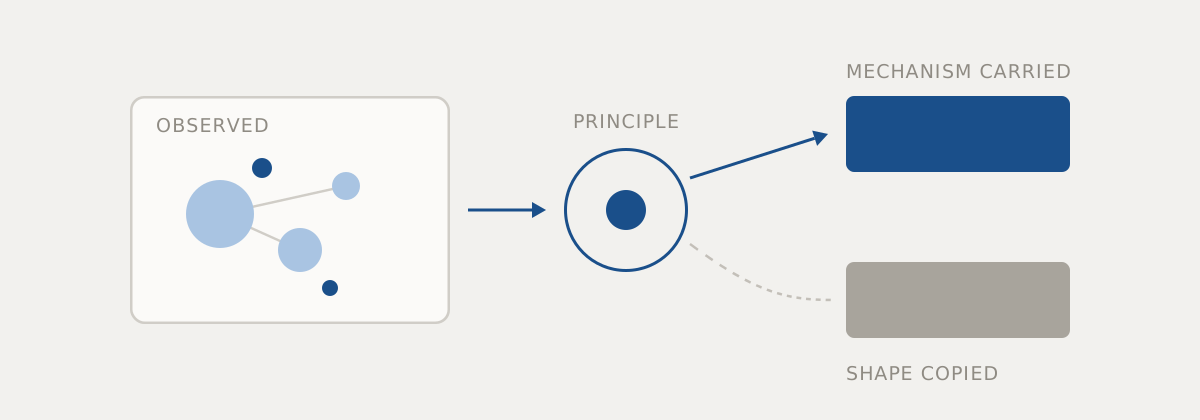
Someone brings a photograph to the design review. A seed head, a beetle’s back, a leaf surface under an electron microscope. The room agrees it is remarkable. Then the conversation turns to how the geometry in the photograph could be reproduced in the product, and from that moment the exercise is usually lost.
The photograph is not the finding. The finding is whatever physical mechanism made that geometry worth having, and the geometry is only one implementation of it — one that had to be grown from a cell, in water, at ambient temperature, by an organism that was also doing several other things at the same time. Reproduce the shape and you inherit every compromise it was carrying, without inheriting the reason it worked.
An index problem before it is a design problem
Treated properly, biology is a catalogue of physical problems that have already been solved under real constraints, tested continuously, and thrown away when they failed. That is an extraordinary resource. The difficulty is that it is indexed by taxonomy and morphology, and engineering questions arrive indexed by function.
An engineer needs to look up reversible attachment to an irregular surface without adhesive, or movement of fluid against a gradient with no pump, or a surface that stays clear of settling particles without being cleaned. No biological reference is organised that way. The literature is arranged by organism, by clade, by ecological role — and the mechanism you want may be described in three separate papers about three unrelated species, none of which uses the word you searched for.
The consequence is that the hard part of biomimicry is not creative. It is translational: restating an engineering requirement as a biological function, running the search, and then restating what you find back in engineering terms precisely enough to be evaluated. Teams that skip this and go looking for inspiration find pictures.
Two directions, with very different hit rates
There are two ways into the process and they do not perform equally.
Problem-driven starts with a specification you already have to meet. You abstract it to a function, search for organisms that face a structurally similar problem, and extract candidate mechanisms. The output is a set of options that compete with the conventional solution on the conventional criteria. Some fail immediately. That is the method working.
Solution-driven starts with a phenomenon somebody found striking and looks for a use. It is the direction that produces the memorable stories and the launch imagery, and it has a much worse conversion rate, because it inverts the normal discipline: the requirement is being written after the answer, so it tends to be written to fit. If the resulting specification would never have been proposed on its own, you have not found an application. You have found a justification.
Both are legitimate. Only one belongs on a critical path with a delivery date.
Which force is doing the work at your size
The most reliable way to waste a year is to copy a geometry across a change of scale without checking which physics still applies.
Biological mechanisms are dense with scale-dependent effects. Below a certain feature size, surface forces overwhelm body forces: adhesion that arises from intimate contact across many fine features simply does not appear if you scale the features up, because the contact area no longer follows. Fluid behaviour around a small, slow organism sits in a regime where viscosity dominates, and the geometry that exploits that regime does nothing useful in a fast, large, inertia-dominated flow. Surface texture that repels water at the micron scale loses the effect when the texture is enlarged and gravity begins to matter more than surface tension.
So the abstraction must carry its validity range with it. Not “this surface sheds water” but “this surface sheds water because of features at roughly this size, in this wetting regime, and the effect degrades as feature size grows”. An abstraction without that envelope is not a principle. It is a rumour.
Biology grows; we do not
The second filter is manufacturing, and it eliminates more candidates than physics does.
Living structures are grown: assembled from the inside out, at body temperature, in water, over a long period, often with the capacity to remodel themselves under load and repair themselves after damage. That process produces hierarchical architectures — structure at several nested length scales at once — that are extremely difficult to reach by cutting, moulding, or depositing material.
This is why so many promising mechanisms stall at the point of making them. The principle is sound, the physics scales, and there is no route to producing the required architecture at volume, at cost, in a material that survives the service environment. A biomimetic proposal that has not been costed against a real process is not yet an engineering proposal.
The honest version of the constraint is a search filter rather than a disappointment. Add manufacturability to the abstraction step and you stop generating candidates that were never going to survive contact with a factory. You will find fewer mechanisms and lose fewer months.
What a good extraction actually looks like
The output of a competent biomimetic study is not a shape. It is a short statement of the form: this function is achieved by this mechanism, which depends on these variables, holds over this range, and requires these manufacturing capabilities. It should be legible to an engineer who has never looked at the organism, and it should be falsifiable — you should be able to build a crude version that isolates the mechanism and see whether the effect appears at all.
That crude version matters more than it sounds. It separates the mechanism from the aesthetic. If a rough, ugly, entirely non-biological article reproduces the effect, you have the principle and you can now optimise it on your own terms. If the effect only appears in something that looks like the organism, you have probably not identified the mechanism yet.
The realistic claim
Biomimicry does not deliver finished designs, and the field’s reputation suffers whenever it is sold as though it does. What it reliably delivers is candidate mechanisms that would not have been generated from first principles, because first principles start from the conventional solution and iterate outwards from there. Biology iterated from somewhere else entirely, under different constraints, for a very long time, and it kept only what worked.
That is worth searching. It is not worth photographing.